
An exploration on how history has shaped Black mental health today
Location: United Kingdom
Aaron Campbell

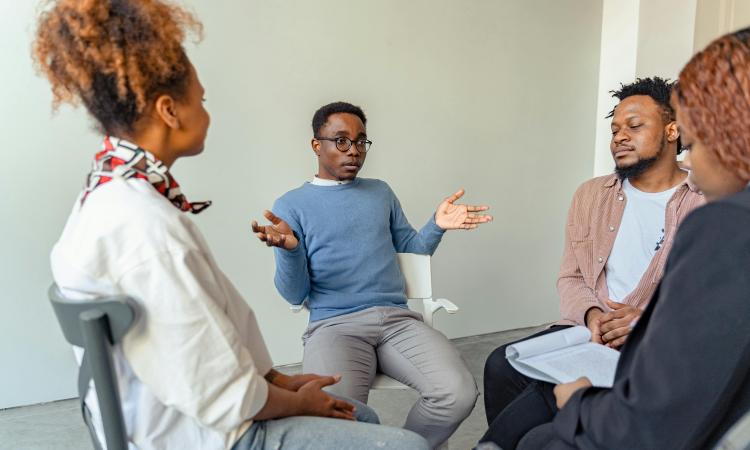
This piece explores some of the historical factors that affect mental health within the Black community, explains how this history shapes Black mental health today, why ‘resilience’ can be a double-edged term, and what should change to address these inequalities.
This piece explores topics of racism and discrimination which some may find upsetting, please read with care. There are details of where to find support at the bottom of this page.
Understanding resilience
“Resilient” is a term often used to describe the Black community, and while not an innately negative word, not enough consideration has been given to the impact that term has within the context of Black mental health and wellbeing.
We all need resilience. By definition, being resilient means being able to adapt to life's misfortunes and setbacks, something which is vitally important to our mental health and wellbeing. However, there are important nuances within this definition. When the setbacks are rooted in things like systemic racism and discrimination we must ask if the term is truly being used to empower or being used to cover over centuries of complex trauma. Resilience helps people cope; it should never be used to excuse systems that cause harm.
The history of Black mental health
To understand this a bit better let’s look to the past. Throughout history Black people have experienced neglect, racism, and discrimination by healthcare institutions who were either unwilling or unable to cater to their needs. This has been the result of historical legacies of colonialism, slavery, and historical malpractice1.
Even the idea of resilience within the Black community can be traced back to a racist myth that Black people have thicker skin or less sensitive nerve endings than white people – a statement which 40% of white medical trainees believe6. Because of everything that Black people have endured throughout history there is this idea that they are “stronger” an idea which not only is untrue but has many unintended consequences for mental health. It’s also important to note that those living today still feel the trauma and impact on their mental health of the historical racism, discrimination and colonialism their ancestors experienced through intergenerational trauma, so even Black people who did not experience a trauma directly may have inherited trauma symptoms, such as anxiety and mood dysregulation7.
A lack of a discussion around mental health
Despite positive steps and contributions towards Black mental health (see: The unsung heroes of Black history and mental health) there is often still a lot of taboo around mental health and talking about mental struggles. A recent study showed that Black people are significantly less likely to seek mental health treatment8 as well as being less likely to talk openly and honestly about mental health struggles. This is in part due to the perception of strength discussed earlier, resulting in the perception among some Black people that talking about mental health may be seen as a sign of “weakness” or “vulnerability”.
How do we address these inequalities?
Both as individuals and as a community there is much, we can do to address these inequalities including:
- Lobbying mental health service providers and policymakers to increase cultural competence, improve data collection, increase representation, and co-produce services with communities.
- Lobbying government to change legislation, such as the Mental Health Act, to address embedded racial injustice and reduce disparities in detention rates as well as financially support policies and programs that increase access to culturally appropriate care, reduce economic disadvantage, and increase interpreter availability.
- Ensuring anti-racism frameworks are implemented within mental health services.
- Increase representation of Black people on boards and in leadership positions within mental health. This helps create more equitable services by ensuring their experiences are considered.
- Ensuring services are accessible, culturally appropriate, and address the impact of racism and socioeconomic factors.
- Advocate for systemic change and hold institutions accountable for addressing racial inequality in mental health care.
- Seek, support, highlight and/or create spaces, that offer support to the Black community.
Understanding the past and looking to the future
There is still much to be done to address inequalities for Black people within mental health. For allies it is important to consider language (like using the terms "strong" or "resilient without considering the context) and address any biases (either conscious or unconscious) that could be creating barriers.
And for those in the Black community, remind yourself and those around you that it is okay not to be okay, we all experience mental health struggles, and your lived experience adds in an additional layer of intricacy. Resilience is important, but so is vulnerability. It is also important to remember our intersectional identities and the complexity, care and consideration that need to be given also, while as community Black people share a lot of struggles through things like intergenerational trauma and shared experiences racism, the community is not monolithic, everyone is still a unique individual and that needs to be considered in support. With that being said don’t be afraid to reach out when you need help and uplift others around you to reach out for help also.

Mental health support for Black people
If you’re Black you may face difficult experiences, like discrimination and microaggressions, that can affect your mental health. It may feel helpful to get support from an organisation with a deeper understanding of your lived experienced. (This doesn’t mean that other mental health services aren’t for you – as services should always be inclusive and welcoming.) Below are some organisations to check out.
- Black Minds Matter UK – A charity that provides up to 10 sessions of fully funded 121 talking therapy for the Black Community, delivered by our amazing cohort of registered associate Black therapists.
- The Empowerment Group - is an award-winning registered charity that supports people of Black African and Caribbean heritage aged 14 and over in the UK facing mental health challenges. This is achieved through free online 1:1 culturally appropriate therapy.
- African and Caribbean Mental Health Services - ACMHS is a community-based organisation providing free and confidential culturally appropriate services predominantly to African and African Caribbean communities as well as other minority groups
- The Black, African and Asian Therapy Network - Home of the largest community of Counsellors and Psychotherapists of Black, African, Asian and Caribbean Heritage in the UK
- Black Mind - A grassroots art-as-activism organisation that centres the collective mental health, wellbeing, justice and joy of Black people in Britain.
- BAYO - From the Yoruba word meaning 'Joy has found us' it is a space to find collectives, organisations and services from across the UK, for the Black community, to support your mental health and wellbeing.
- African Rainbow Family - Charity that supports people seeking asylum and refugees who are LGBTIQ+ and have African heritage.
- Refugee Council -The nation’s refugee charity having a positive impact on refugees and changing their lives for the better.
References
- O Ozduzen et all, 2022, “Medicine is still against Black people": Mapping and visualising intersections of social inequalities, community mistrust, and vaccine hesitancy in online and physical spaces in the UK and US, The British academy
- G Iacobucci, 2022, ‘Most Black People in UK Face Discrimination from Healthcare staff, Survey Finds’ The British Medical Journal, Issue 378
- GOV.UK, 2023, ‘Detentions under the Mental Health Act’, NHS Digital
- M Knight, 2021, Saving Lives, Improving Mothers' Care 2021 – Lessons learned to inform maternity care from the UK and Ireland Confidential Enquiries into Maternal Deaths and Morbidity 2017-19, MBRRACE-UK
- T Thomas, 2024, Black women in England suffer more serious birth complications, analysis finds, The Guardian
- K Hoffman et all, 2016, Racial bias in pain assessment and treatment recommendations, and false beliefs about biological differences between blacks and whites, Proceedings of the National Academy of Sciences
- M Bowers, R Yehuda, 2015, Intergenerational Transmission of Stress in Humans, Neuropsychopharmacology
- 2025, Understanding Mental Health in Black Communities, Deconstructing Stigma