
The arts give us a way to tell our stories, to hear other people’s stories and to find connection through them. And when it comes to mental health, that connection can be incredibly powerful.
Gail Aldam

Storytelling and mental health have an incredibly powerful connection.
Seeing something that reflects your own experience, whether that’s on screen, on stage, in a book or through music, can make you feel less alone. There is something profound and moving in recognising a part of your own experience in somebody else’s story and realising that your experience is valid and shared by others.
But storytelling can also take us beyond our own experiences.
A film, performance, piece of writing or song can give us an insight into a life we haven’t lived ourselves. It can help us understand another person’s perspective and build empathy. In doing so, the arts can challenge some of the misunderstanding and stigma that still exists around mental health.
When the festival began 20 years ago, we focused on using the arts to raise awareness and challenge stigma. That is still a vital part of what we do. But over time, I think our understanding of the role of the arts has become broader.
Yes, participating in the arts can make us feel good, and there is evidence for the way it can support wellbeing. But art can do something else too. It can reach people in ways that more traditional campaigning sometimes can’t. It gives us space to sit with somebody else’s experience, to question what we think we know and, perhaps, to see the world differently.
At its best, art builds empathy, understanding, connection and community, all of which have an important role to play in helping people live mentally healthier lives.
A festival shaped by lived experience
This belief is reflected in how we create the festival.
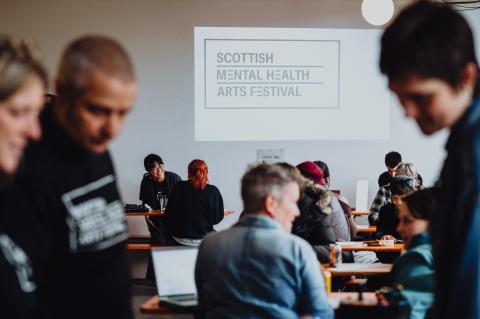
Our planning group includes people with experience of mental health issues from across Scotland, who help shape the programme. And our programme is deliberately broad. You might find touring theatre or a high-profile performer alongside a very local event, such as a knitting group meeting in a community centre.
And these events are equally important. A small community event can have just as meaningful an impact on the people who organise and attend it as something taking place on a much bigger stage.
We also want the programme to reflect the diversity of our audiences. You don’t need a background in the arts, or to think of yourself as a regular festival-goer, to take part. We want people to be able to look through the programme and find something that feels like it’s for them.
That means thinking about practical barriers too. We aim to keep our events are free or low-cost, with sliding-scale payments where appropriate, because cost shouldn’t prevent someone from being part of the festival.
Supporting the people who tell their stories
One thing we’ve increasingly thought about over recent years is the experience of the artists themselves.
Working with filmmakers, writers, musicians and performers has reminded us that sharing creative work about mental health can ask a great deal of an artist, particularly when that work draws on deeply personal experiences.
We want to celebrate people for telling those stories, but we also have a responsibility to think about what it means to ask someone to keep telling, performing or discussing them in public.
That’s why we’ve developed resources such as Performing Anxiety and this good practice resource for Participatory Arts and Mental Health to support artists in navigating some of those challenges, and are working with Creative Scotland to develop an Arts and Mental Health Framework.
Twenty years of connection
Perhaps one of the strongest indications that the festival matters is that people keep coming back.
I first joined the festival team as a volunteer 19 years ago, and since then I’ve watched it grow and reach more and more people across Scotland. What has remained constant over the last two decades is the sense of community at its heart.
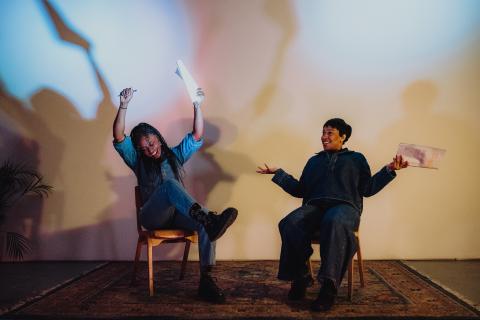
Over the years, we’ve built an incredible community around the festival. Some people have been involved for many years, returning as artists, contributors, volunteers, audience members and partners. Again and again, we see how much people get from taking part: the connections they make, the conversations that begin, and, importantly, the feeling that their experiences have been seen, heard and listened to.
Over 20 years, it has grown from an idea for a weekend film festival in Glasgow to reach audiences of almost 20,000 across Scotland each year. This year, we received more than 400 entries to our film competition, around 300 entries to our writing competition, and have around 200 events taking place across Scotland.
The model has also inspired festivals internationally, with artists and organisers in Portugal, Ireland, Northern Ireland, the USA and Finland developing work modelled on our approach.
Those numbers are wonderful, of course, but for me, the real story is what sits behind them. It’s seeing what it means to the person sitting in an audience and recognising their experience on stage. Or the artist finding their voice and through their work opening up a conversation. The person who comes along without knowing quite what to expect and leaves feeling more connected than they did before.
After nearly two decades of being involved in the festival, that’s what still feels most important to me.
The Scottish Mental Health Arts Festival runs from 19 October to 8 November in venues across Scotland. View the full programme online at www.mhfestival.com