
An exploration of mental health within the Black community
Location: United Kingdom
Aaron Campbell

This year's theme for Black History Month of 'honoring our communities' is deeply resonant when we discuss mental health. We know that community is good for our mental health. However, many of us may not feel that this statement is true or resonates with us. As within Black communities specifically, there has often been a lot of stigmatisations around discussions of mental health, especially amongst older generations.
We also know that talking about our mental health is a key step in preventing poor mental health. But when it feels like our community does not want or know how to have the discussion we can experience feelings of isolation which can worsen our mental health.
In this piece we will explore some of the ways in which we can begin to shift the conversation on mental health in our communities, as well as highlighting the importance of having the conversations about mental health with ourselves and with service providers.

The wider community conversation
As a community, Black people are disproportionately affected by ill mental health and often face negative experiences when it comes to mental health treatment. These inequalities affect Black people along the entire care pathway from access to diagnosis, assessment, treatment and recovery.
In a 2025 survey of Black people in the UK found that:
"People described stigma as one of the main barriers to accessing mental health services – both in terms of the way communities often viewed mental illness as a sign of weakness or shame, and past experiences that have led to distrust in services. This was also reflected in the findings of the Ipsos survey, where professionals reported that cultural stigma can lead to a reluctance to seek help, disclose symptoms and engage with medicine. Differing cultural beliefs and practices related to mental health and wellbeing can also lead to misunderstandings and misdiagnoses."
The state of health care and adult social care in England 2024/25 - Care Quality Commission
We also know that:
This is why it is vitally important that we create spaces within our community to have discussion about mental health. Some of the ways in which we can do this include.
- Creating/finding safe spaces for conversation - This could be while preparing dinner, during a walk etc. Spaces where people feel most relaxed often create space for the best conversation.
- Putting names to feelings - Often one of the biggest barriers to talking about mental health is that many in the community do not have the language to talk about mental health struggles. We can help this by giving them the tools and the language to describe their feelings for instance if a family member said “I'm really tired all the time and I feel like everything is a lot” you could respond with “are you perhaps experiencing burnout?”.
- Being open about our own experiences - Sometimes the biggest driver for change can be proactively talking openly and honestly about our own experiences and inviting people to share their own or inviting conversation by asking someone if they can relate to these feelings. For example: “I don't know about you, but sometimes I really struggle with depressive episodes/feeling low”.
- Make discussions about mental health culturally appropriate – make the discussion feel more relevant by including elements that are more culturally specific, this could be using language, relating the conversation to background and/or identity. For more tips on this visit the CQC website.
These are just some of the ways that we can begin to destigmatize discussions on the topic of mental health. It's important when creating these spaces and having these conversations that we make sure to bring in everyone, in particular those from older generations may struggle more than those from younger generations to open up about mental health for a number of reasons including intergenerational trauma and generations of conversations around mental health being deeply stigmatised. It is vital to recognise that across the diaspora the challenges faced cannot be fixed overnight, having more conversations as a community about mental health will require small steps for progression and change.
Supporting your own mental health
As important as it is to have conversations about mental health with your community you must also be able to have conversations and check-ins with yourself. Looking after your own mental health and wellbeing is vital. Across the website there are a bunch of resources for looking after yourself including:
Another key way to understand our own mental health as people from the diaspora is to look at the context in which we find ourselves currently. This includes historical factors that shape how Black people approach mental health and resilience and how that still has an impact in current day through intergenerational trauma, medical racism and other means. For more on this you can read my previous piece titled: Black mental health and resilience.
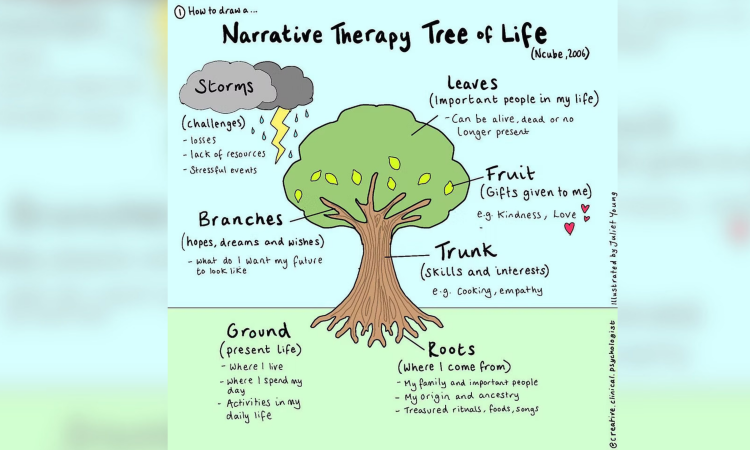
Another tool that we can use is called the 'Tree of Life' - it is a strengths-based tool (looking at our individual strengths and resources rather than concentrating on vulnerabilities) that we can use to map out the narrative of our life and support our mental health and wellbeing. The model uses a tree to tell our life story with each part of the tree symbolising a different aspect:
- Ground (present life)
- Where I live, where I spend my day, activities in my daily life
- Roots (Where I come from)
- My family and important people, my origin and ancestry, treasured rituals, foods, songs
- Trunk (skills and interests)
- e.g. Cooking, empathy
- Branches (hopes, dreams and wishes)
- What do I want my future to look like
- Leaves (Important people in my life)
- Can be alive, dead or no longer present
- Fruit (Gifts given to me)
- e.g. Kindness, Love
- Storms (challenges)
- Losses, lack of resources, stressful events
It is important to know and look after ourselves so that we can be an active and contributing member of our community. While the tools and methods described above are great ways of helping ourselves there may come a time when we need more specific support from experts and it's important that we recognise when we might need this help and how we can approach dealing with mental health service providers.
Getting support from service providers
It can often feel quite daunting to seek support when you need it and we know that Black people often face worse outcomes when seeking said support. Recognising when you need help and taking the steps to seek out support services is an incredibly brave thing to do. Here are some things that are good to know when seeking support as a Black person:
- You have the right to ask for a Black healthcare professional when seeking support – You may find it easier to speak to some from the same or similar background. This includes for things like GP visits as well.
- Seek culturally appropriate support – Services that respect, understand, and integrate a person's cultural identity, background, language, and beliefs into their care can be considered culturally appropriate – check out the bottom of this page for resources to find these particular services.
- Speak about your culture and background - You can explain to mental health service providers how your culture and background is relevant to your mental health problems. This will help to create better understanding and could help shape your care and treatment in a more preferable way.
- Understand your rights – You are protected under the Equality Act 2010. As such all service providers legally cannot discriminate against you because of your race. If you have been discriminated against you can get free expert advice on what you can do from Equality Advisory and Support Service (EASS).
- Bring a friend or relative to your appointment – You are allowed to take a trusted person to an appointment. They can support you and bringing them might ease any anxiety you have. They may also be able to speak on your behalf.
It is always important to advocate for ourselves and for other so that we are all getting the right kind of care that respects our identity, background, culture and supports in a way that truly helps.
Specific mental health support for Black people
If you’re Black you may face difficult experiences, like discrimination and microaggressions, that can affect your mental health. It may feel helpful to get support from an organisation with a deeper understanding of your lived experienced. (This doesn’t mean that other mental health services aren’t for you – as services should always be inclusive and welcoming.) Below are some organisations to check out.
Black Minds Matter UK – A charity that provides up to 10 sessions of fully funded 121 talking therapy for the Black Community, delivered by our amazing cohort of registered associate Black therapists.
The Empowerment Group - is an award-winning registered charity that supports people of Black African and Caribbean heritage aged 14 and over in the UK facing mental health challenges. This is achieved through free online 1:1 culturally appropriate therapy.
African and Caribbean Mental Health Services - ACMHS is a community-based organisation providing free and confidential culturally appropriate services predominantly to African and African Caribbean communities as well as other minority groups
The Black, African and Asian Therapy Network - Home of the largest community of Counsellors and Psychotherapists of Black, African, Asian and Caribbean Heritage in the UK
Black Mind - A grassroots art-as-activism organisation that centers the collective mental health, wellbeing, justice and joy of Black people in Britain.
BAYO - From the Yoruba word meaning 'Joy has found us' it is a space to find collectives, organisations and services from across the UK, for the Black community, to support your mental health and wellbeing.
African Rainbow Family - Charity that supports people seeking asylum and refugees who are LGBTIQ+ and have African heritage.
Refugee Council -The nation’s refugee charity having a positive impact on refugees and changing their lives for the better.
References
- Sense of community and mental health - https://pmc.ncbi.nlm.nih.gov/articles/PMC10314672/
- Care Quality Commission, The state of health care and adult social care in England 2024/25 -https://www.cqc.org.uk/publications/major-report/state-care/2024-2025/focus/bmmh
- Mental health UK, Black, Asian and Minority Ethnic mental health - https://mentalhealth-uk.org/black-asian-and-minority-ethnic-bame-mental-health/
- The SPRINT Project, The Tree of Life: A Therapeutic Strengths-Based Activity - https://www.sprintproject.org/post/the-tree-of-life-a-therapeutic-strengths-based-activity
- The Dulwich Centre, The Tree of Life - https://dulwichcentre.com.au/the-tree-of-life/