
This Mental Health Awareness Week we’re focusing on action for good mental health. We’re sharing our best, evidence-backed tips to inspire people to try a quick wellbeing boost or stick at a healthy habit with a view to making lasting changes. Different things will work for different people, so it’s worth trying a few approaches to find those that work best for you.
What does good mental health look like?
Good mental health is a state of emotional wellbeing that lets us cope with normal life stresses, feel confident and enjoy our relationships with others. When life feels more challenging than usual, it’s often a sign that our mental health needs some extra care and attention.
The good news is that protecting our mental health is easier than you might think. Taking practical steps to improve our mental health may feel daunting, but it doesn’t have to be. Even small and simple actions can make an impact.

Daily actions matter
Improving your mental health can seem like a huge task, especially if you feel overwhelmed or unsure where to start. But you don’t have to make big changes overnight.
Small changes in your routine can make a real difference to your emotional wellbeing and improve mental health long-term.1 Plus, it’s often easier to stick to new habits when they are quick and easy to fit into your routine.
Consistent action leads to habits
When you consistently repeat healthy actions, they can become habits, which means you may begin doing them almost without thinking. Simply put, consistency leads to benefits (such as lasting wellbeing) without much mental effort. This is valuable because you can rely on routines to boost your mental health, rather than waiting to feel motivated. Plus, having a routine can help maintain a sense of control even when life feels chaotic. This predictability can help reduce anxiety.12
Long-term benefits of creating sustainable mental health habits
Creating sustainable wellbeing routines can offer long-term benefits as well as instant stress relief and mood boosts. Some of these long-lasting benefits include:9-11
- Feeling more emotionally stable
- Better physical and mental health
- An improved sense of self-esteem
- Being able to manage stress better
- Enhanced emotional regulation
- Feeling more connected to others
Where should I start?
There are two main types of positive action you can take for mental health: short-term and long-term. Understanding the difference can help you decide which actions to concentrate on, depending on the challenges you face.
Short-term actions
Short-term actions are quick. You could think of them as ‘easy wins’ for a quick boost when you need help. Some examples include:
- Grounding exercises when you feel anxious
- Deep breathing when you feel stressed
- Stretching if your shoulders feel tense
- Listening to a guided meditation
- Putting on an upbeat song to lift your mood
These actions can be done in the moment to provide quick relief from unpleasant feelings.
Long-term habits
Long-term actions are carried out consistently over time to enhance your everyday wellbeing. Examples of long-term actions for wellbeing include:
- Eating a healthy diet
- Regularly exercising
- Starting a daily mindfulness practice
- Attending a weekly yoga class
- Maintaining a good sleep routine
Consistency is key when creating long-term mental health habits. You may not notice instant benefits as you would with short-term actions, but over time, they can bring lasting improvements.
Putting knowledge into action
To take action, you first need to know what would help you. This often begins with understanding what affects you most. For example, you could take a non-judgemental, honest look at your diet or exercise routine and identify small, consistent changes you could make to improve long-term wellbeing. Adding one positive action to your routine, such as eating an extra piece of fruit or taking a short walk each day, could become a long-term habit in time.
You could also consider situations that trigger unpleasant feelings, helping you pinpoint in-the-moment actions for stress management. For instance, if anxiety is a recurring challenge, then you may want to practise grounding exercises or breathing techniques for in-the-moment relief.
This way, you'll have techniques for relieving anxiety while also knowing that you have healthier habits to support your future wellbeing.
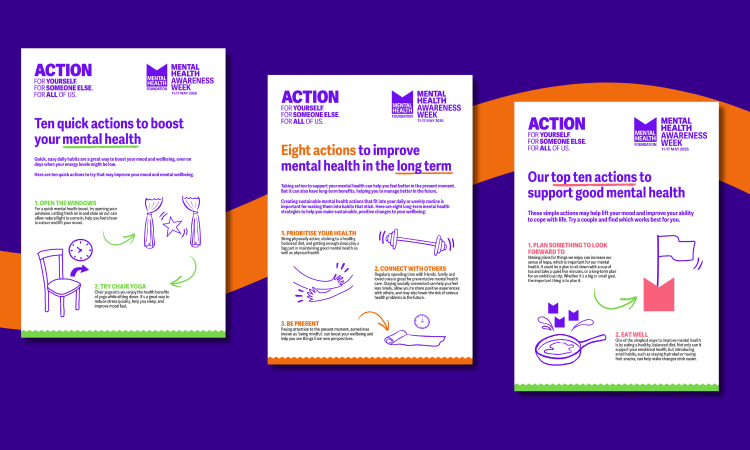
Five daily actions to try
There are lots of simple mood-boosting actions that should easily fit into your daily or weekly routine. However, we're all different, and some of these actions may feel easier for you than others. That’s why it can be useful to try a few different ideas and find what works best for you. Here's five suggestions for adding a quick mental health boost to your daily routine.
1. Spend time in nature
Spending time in nature can lift your mood, reduce stress levels and help you concentrate.2 To make this part of your daily routine, try stepping outside for a breath of fresh air before eating lunch or going for a walk on the weekends.
2. Connect with loved ones
Spending time with friends, family and loved ones is a great way to improve mental health. Sharing your experiences and supporting one another can help you feel happier, more connected and less alone with your problems.3,4 Whether it’s a quick phone call or meeting a friend for lunch, keeping in touch can help lift your mood.
3. Live a healthy lifestyle
An obvious one, but treating your body well can have positive effects on your mental and emotional health, too. Being physically active, eating a healthy, balanced diet and getting good quality sleep can help boost mental wellbeing.5 To build these into your daily routine, consider actions such as eating fruit for a mid-morning snack or stretching when you first get out of bed.
4. Get creative
Picking up creative activities, such as knitting or writing, can help ease stress and anxiety by letting you take a step back and relax. They are also really positive ways to express yourself, build emotional resilience and boost mental health.6,7
5. Relax
Finding time to relax each day can help you feel better if you’re stressed or worried.8 But first, it’s good to figure out what makes you feel calm. For instance, you could try practising breathing exercises, taking a warm bath or shower, or listening to calming music.
Find out more
Find out more about Mental Health Awareness Week and how to get involved.
Get involved
References
- Arlinghaus, K. R., & Johnston, C. A. (2018). The importance of creating habits and routine. American Journal of Lifestyle Medicine, 13(2), 142–144. https://doi.org/10.1177/1559827618818044
- Mental Health Foundation. (n.d.). Nature: How connecting with nature benefits our mental health. https://www.mentalhealth.org.uk/our-work/research/nature-how-connecting-nature-benefits-our-mental-health
- NHS Website. (2025, July 4). 5 steps to mental wellbeing. https://www.nhs.uk/mental-health/self-help/guides-tools-and-activities/five-steps-to-mental-wellbeing/
- World Health Organization: WHO. (2025, June 30). Social connection linked to improved health and reduced risk of early death. https://www.who.int/news/item/30-06-2025-social-connection-linked-to-improved-heath-and-reduced-risk-of-early-death
- University of Cambridge. (2023, September 11). Healthy lifestyle can help prevent depression – and new research may explain why. https://www.cam.ac.uk/research/news/healthy-lifestyle-can-help-prevent-depression-and-new-research-may-explain-why
- APA. (2023, July 6). New APA poll: Americans who engage in creative activities at least weekly report better mental health. https://www.psychiatry.org/news-room/news-releases/new-apa-poll-americans-who-engage-in-creative-acti
- UCL. (2025, September 17). Creative activities help the brain to cope with emotions. https://www.ucl.ac.uk/news/2019/may/creative-activities-help-brain-cope-emotions
- Mental Health Foundation. (n.d.). Stress. https://www.mentalhealth.org.uk/explore-mental-health/a-z-topics/stress#paragraph-56833
- Ma, Y., & Mumtaz, S. (2025). The long-term mental health benefits of exercise training for physical education students: a comprehensive review of neurobiological, psychological, and social effects. Frontiers in Psychiatry, 16, 1678367. https://doi.org/10.3389/fpsyt.2025.1678367
- Prakash, J., Chatterjee, K., Srivastava, K., Chauhan, V. S., & Chail, A. (2020). Role of various lifestyle and behavioral strategies in positive mental health across a preventive to therapeutic continuum. Industrial Psychiatry Journal, 29(2), 185–190. https://doi.org/10.4103/ipj.ipj_126_20
- McGrath, P. (2024, September 19). 11 healthy mental health habits to calm your mind. NOCD. https://www.treatmyocd.com/blog/11-healthy-mental-health-habits-to-calm-your-mind
- NIH News in Health. (2024, June 17). Breaking bad habits. https://newsinhealth.nih.gov/2012/01/breaking-bad-habits